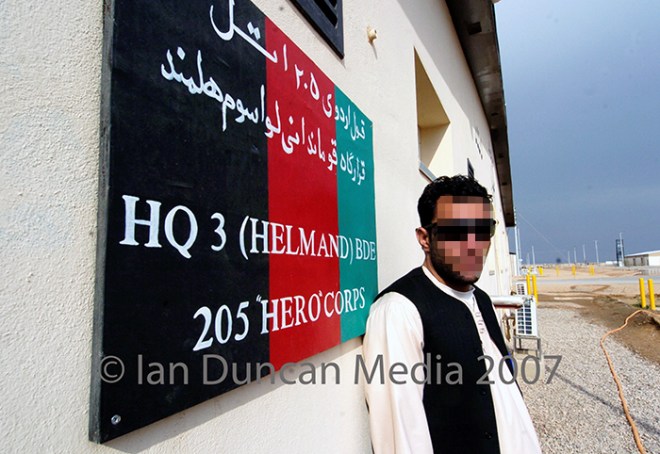

WHEN given the chance to hide his identity with a scarf the interpreter gives a surprising response – “I don’t want to look like a terrorist,” he said.
Civilian workers employed by Task Force Helmand could be doing one of the most dangerous jobs in the world because their role easily marks them out as a target for assassination by Taliban supporters.
Radio broadcasts have been heard which urge Afghan people to “shoot the eyes” of coalition forces in an attempt by the Taliban to regain influence in Afghanistan.
He grew up in the Ghanzni province, near Kabul, and is working with members of 2nd battalion The Yorkshire Regiment (Green Howards) during its current six-month tour of duty in the Helmand province.
He said: “We are risking our lives. We are listening to the Taliban radios and they are saying shoot the coalition’s eyes which means the interpreters.”
Originally he worked for the American Army as an interpreter and has four years experience.
He said: “Under the Taliban we were running secret schools and they didn’t know we had a good teacher.
“In 2001 the coalition forces came and took over from the Taliban. There were schools run by the Government. For two years I studied at school and learned English.”
He added he saw an advert in Kandahar – the neighbouring province to Helmand – which welcomed applications from people to be interpreters.
A lot of his present work involves talking to local people, while out on patrol with British soldiers, to reassure them and highlight their concerns.
The main native languages in Afghanistan are Persian, or Dari dialects, and Pashto, as well as a number of minor languages including Balochi, Nuristani, Pashai, Brahui, Pamiri, Hindko and Urdu.
And the 24-year-old interpreter said: “I feel that this is a good job. We are helping our people. If there are no interpreters the soldiers couldn’t talk to our people.”
Cpl Carl Storr, 30, from Whitby, is currently stationed in Afghanistan’s Helmand province with 2 Yorks and works with interpreters – who are known among soldiers as “terps” – on a daily basis.
He said: “We had to make sure each company had enough interpreters. They aren’t too bad, but they are civilians.
“It is hard to get them to work to our way of thinking.
“They are friendly but if they have got a problem they will come to you expecting you to sort it there and then.
“When they go out on the ground each team will try and mentor the terp and try to explain things to him to try and get good enough working relationships with them. Sometimes it’s rewarding and it can be challenging as well.”
From The Scarborough Evening News on Tuesday, January 8, 2008.
 Ian Duncan Media