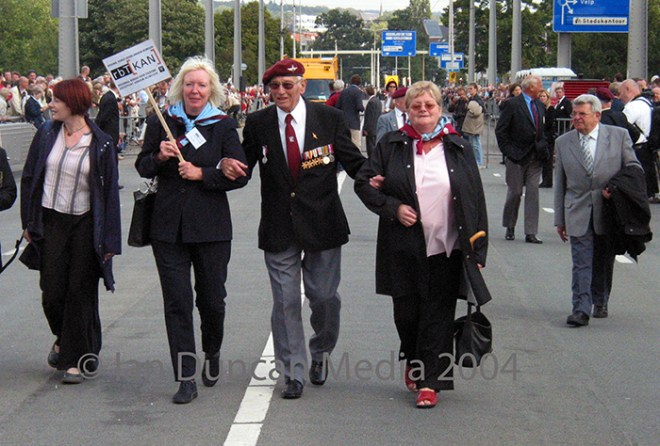
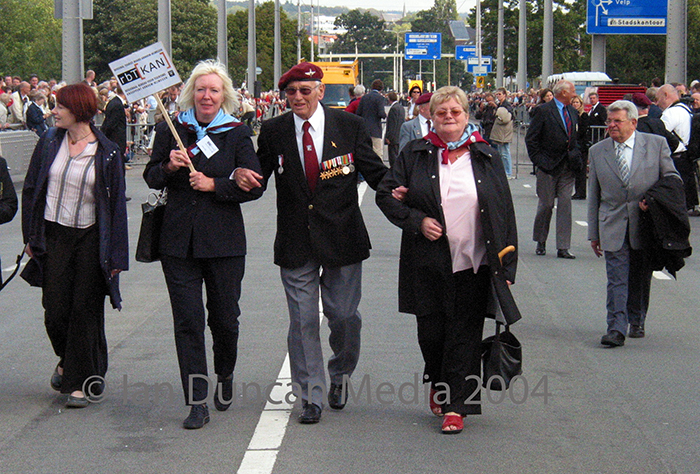
ARTHUR Sobey was today making an emotional return to the scene of his capture during one of the most famous Second World War battles.
The 84-year-old veteran was a member of the 3rd Battalion Parachute Regiment under the command of Lt-Col John Fitch and they were battling towards their objective – the bridge at Arnhem.
The battle began 60 years ago and Mr Sobey was attending special events to commemorate Operation Market Garden — the biggest military airborne operation in history.
This special trip has been organised by P&O Ferries and the Arnhem and Nijmegan Regional Tourist Board, to honour veterans.
And, today at noon, he was due to stand on the John Frost Bridge — a job he could not manage in 1944. On September 17, as part of the 1st British Airborne Division, he parachuted into Holland as part of an invasion force of 35,000 allied troops.
Before going, he said they were ‘kept in the dark about the operation’.
“We were confined in the barracks and no-one told us about what we were doing until just a few days before,” he said.
“We did not set off until 1.30pm, but it was so quiet, considering how many people were taking part. I was a bit nervous but I decided I just had to take it in my stride.”
He said he was feeling ‘apprehensive’ during the flight. He said: “I was wondering what we were going to find over there.
“We were told there were very few enemy troops left and they were just old men. But actually there were two divisions of armour there, outside Arnhem.”
Mr Sobey said his battalion landed in a quiet spot and made quick progress to the town of Arnhem, where his battle was to begin in earnest.
He advanced with his comrades towards the bridge, which they had been ordered to capture, as part of the operation which had been masterminded by Field Marshal Bernard Montgomery.
A big problem for the battalion, and all the allied troops, was poor communications.
“The radios were basically useless. We were trying to contact other allied battalions but the radios hardly worked,” he said.
Soon they came under heavy fire from German tanks and had to take refuge in Dutch houses, moving from building to building to try and make their advance.
Mr Sobey said: “When we got there, there were two divisions of armour. Infantry can do nothing against armour. We were so outnumbered we had to go into the houses and barricade ourselves in.”
He added: “You just feel gutted, there’s nothing you can do about it. There’s no way out of it, that’s all I can say.
“We were in the houses on the side of the road, the armour was sitting on the road, there’s nothing you can do about it.”
Mr Sobey said: “They threw hand grenades at us and put shells through the roof from the tanks, I thought ‘that’s it, we’ve had it’. We gave up. It was either that or be killed – what do you do?”
They were only half a mile from their objective. He was captured and taken to Germany as a prisoner of war.
The operation ultimately ended in failure and after the defeat, the war was to drag on through another long and hard winter.
But the soldiers involved were still hailed as heroes for their bravery and playing their part in one of history’s most dramatic battles.
After the war ended in 1945, Mr Sobey moved back to England and moved to Surrey where he joined the police force.
He retired in 1980, and four years later moved back to his roots, and settled in Barton-upon-Humber.
Mr Sobey said the visit would be an ’emotional’ time for him. “When we go to the cemetery, it will bring back memories.”
A parachute drop by some of the veterans has been arranged on Saturday, as part of the commemoration.
He said he wished he was fit enough to take part in the jump.
“I couldn’t, my legs couldn’t stand it,” he said.
“I think I’m getting a bit old for that sort of thing now,” he added.
But he said he was looking forward to the trip. But he felt, realistically, it would be his last chance to pay his respects to his fallen comrades.
“After all, 60 years is a long time,” he said.
Operation Market Garden factfile:
• The ill-fated Battle of Arnhem was part of a daring airborne offensive which, if successful, would have changed the course of history;
• It formed part of a campaign called Operation Market Garden which was masterminded by Field Marshal Montgomery;
• Some 35,000 Allied troops were to parachute into the the Netherlands for a surprise attack;
• Its aim was to secure a number of bridges on the Dutch-german border;
• Operation Market Garden had two purposes: the occupation of the bridges (Market) and the advance of the 2nd British Army (Garden);
• The US 101st Airborne Division was allocated bridges north west of Eindhoven, while the US 82nd Airborne were to drop north east of them to take the bridges at Grave and Nijmegen;
• The British 1st Airborne Division and Polish 1st Independent Parachute Brigade were to take the bridges at Arnhem and Oosterbeek;
• The Americans were to hold the road open for the British Army;
• British tanks and infantry would then punch their way through to Arnhem relieving the 1st Airborne Division within 48 hours;
• The ultimate aim of Operation Market Garden was for Allied troops to then storm forward striking into Germany in one concentrated blow;
• But despite the heroic efforts of British, Polish and US forces it ended in crushing defeat;
• On September 17, 1944, the first parachutists were air dropped into The Netherlands — around 10,000 men landed which was less than one third of the total airborne offensive;
• A shortage of planes meant the rest were to be dropped over two consecutive days;
• The distance from their point of landing to Arnhem Bridge meant British paras had to cover up to eight miles before reaching their destination. This meant they lost the element of surprise giving the Germans time to react;
• And the Germans discovered objectives from day one when they captured maps and plans of the entire operation from a downed glider;
• The American 101st Division captured one bridge although at Son was blown up as they approached;
• The 82nd took the bridge at Garve but the bridge at Nijmegen remained in German hands;
• Two of the three brigades which made up the British 1st Airborne failed to reach the bridge in Arnhem because of fierce German resistance;
• Less than 700 paras got through to the northern end of Arnhem Bridge;
• They had expected to hold their ground for just 48 hours but their back up never arrived;
• British paras at Arnhem ran out of ammunition after they had fought for nearly four days to hold their ground;
• Lt Col Frost’s surrender on September 21was followed three days later by Montgomery’s order for the survivors of the 1st Airborne Division to withdraw;
• A total of 10 British servicemen won the Victoria Cross (VC) during the battle — nine posthumously.
From the Scunthorpe Telegraph on Thursday, September 16, 2004.
 Ian Duncan Media