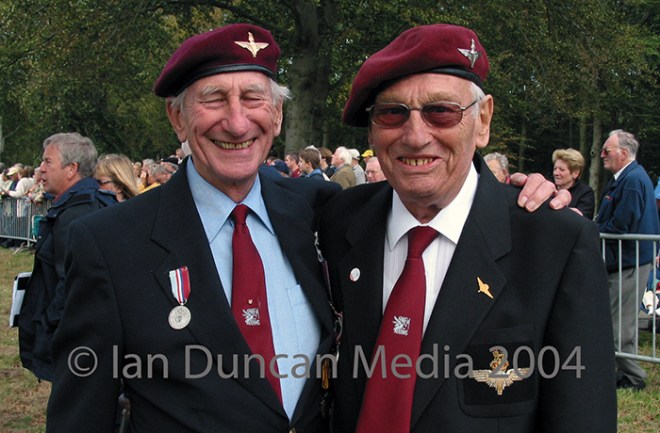
AMONG a sea of red berets at the 60th anniversary of Operation Market Garden a North Lincolnshire Arnhem veteran spotted one of his former brothers in arms.
Arthur Sobey (84), of Barton-upon-Humber, was standing on Dutch soil in Ginkel Heath, where he had parachuted in 60 years ago, when he was reunited with fellow Para, George Thompson, on Saturday.
They had stood together at the exact spot on Sunday, September 17, 1944, after they had been dropped into enemy occupied Holland during World War Two.
The landing ground at Ginkel Heath, a moorland strewn with gorse and purple heather, had not changed in 60 years, said Mr Sobey.
The veterans were serving with the 3rd Battalion Parachute Regiment under the command of Lt-Col John Fitch and were ordered to capture the Rhine Bridge at Arnhem.
And when the former soldiers met they said the operation felt just like yesterday as the memories came flooding back.
“It was the first time we’d been together here in 60 years,” said Mr Sobey. “He is older, but that’s time for you. He’s still the same old George. He was a comrade, he was a great mate. He did a marvellous job, George.”
He recalled an occasion in North Africa when Mr Thompson patched up a wounded soldier. “A Corporal went through a minefield,” he said.
“He hit a mine and it blew his leg off. George bandaged his wounded leg up. He tried to keep him quiet. He was conscious all the time. He gave him some chocolate – that kept him quiet.”
He said it was great to meet his former comrade, because it brought back all of his memories. “Meeting him was a red letter day,” he said.
Mr Thompson said he had not returned to Arnhem for 39 years. “We destroyed the town,” he said. “I said I was not going back, but a Dutch friend said I must come back.”
He remembered all of his former comrades. “They were all characters,” he said. “That’s the thing when you jump with someone, you get a friendship. We were all scared stiff.”
Mr Thompson also well remembered Mr Sobey. He said: “He would stand by you under fire. You could count on him.”
They were both captured the following Wednesday, after they dropped into Holland, half-a-mile from their objective and taken to separate prisoner-of-war camps.
After fighting their way towards Arnhem, they came under unexpected, heavy German fire from two divisions of tanks. Trapped in the houses of Dutch people, they felt they had no choice but to surrender to the Germans.
“We were taken to this big house,” said Mr Sobey. “I can’t remember which one it was, but it was possibly the divisional headquarters.
“We weren’t there long. They moved us out and we had to walk to Apeldoorn in Holland.”
Mr Sobey said they were kept in a big warehouse before being transferred into trains, which transported them further into Germany.
“I remember going through Cologne,” he said. “There was nothing left, it had been flattened. There was just the towers of the cathedral.”
He travelled for two days to Stalag 11B, near Limberg. The conditions in which the prisoners were kept were described by Mr Sobey as ‘basic’ and ‘rough’.
“We never had a mattress,” he said. “The prisoners at the time couldn’t deal with it. We were infested with lice.
“Food was non-existent. We got a slice of black bread, but the guards had the same to eat.”
Conditions improved when he was transferred to a working party — he was fed horse head soup. “The taste didn’t matter,” he said.
He was sent to work in the Herman Goering Steelworks but was soon sacked for ‘messing about’. “We were mucking about at the time,” he said.
His supervisor said he ‘did not want to see them again’. But by the end of March 1945, he was free, his guards had vanished as part of the German retreat to Berlin.
“In the morning the guards had disappeared,” he said. “I was home before the war finished. General Patton’s spearhead came along. I saw his tanks, I heard he said ‘It’s that way boys’ and we were free.”
Mr Sobey was still wearing the beret this week which he was issued with when he was demobbed — a size seven hat stamped with the year 1945.
“I came back to Britain first to see my mother,” he said. “She just threw her arms around me. She was a lovely woman.”
From the Scunthorpe Telegraph on Tuesday, September 21, 2004.
 Ian Duncan Media