PRIVATE Arthur Sobey had good reason to feel apprehensive 60 years ago, because he was about to be dropped into occupied territory.
He was part of a 35,000 strong invasion force, which aimed to liberate Holland from the Nazis. Called Operation Market Garden, it was a plan which was doomed to failure.
And Mr Sobey (84) this week travelled from his Barton-upon-Humber home on a special trip, organised by P&O Ferries and the Arnhem and Nijmegen Regional Tourist Board, to mark the anniversary.
As previously reported, he sat on the John Frost Bridge in Arnhem on Thursday and the gratitude of the Dutch people moved him to tears on a very emotional day.
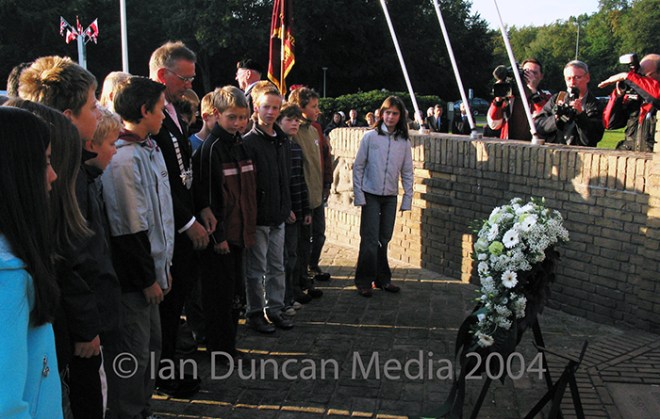
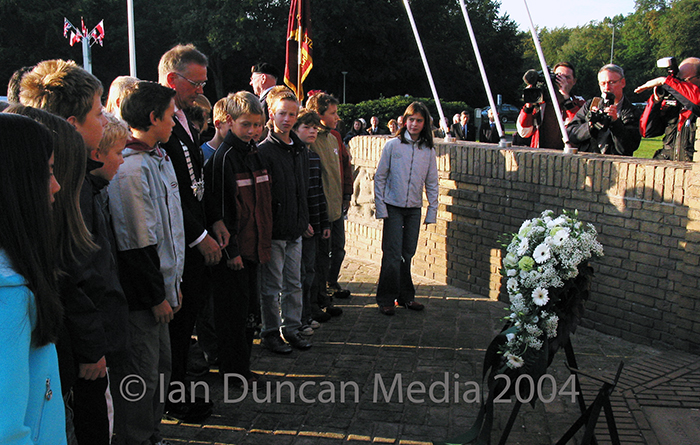
And yesterday, he watched Dutch children lay a wreath at the Oosterbeek Airborne Memorial, to honour fallen heroes from the campaign.
Events of Sunday, September 17, 1944 are still vivid in the paratrooper’s memory and he remembered they were ‘kept in the dark’ before they took off.
He said he did not even know which airbase he had been taken to, but he thought it was in Lincolnshire. He added they had been briefed and knew they were going to Holland.
Pte Sobey was serving with the 3rd Battalion Parachute Regiment under the command of Lt-Col John Fitch and they were ordered to capture the bridge at Arnhem.
“We were up about 9.30am and had to get all the ammunition and parachutes ready,” he said. “We were pleased to get moving, we had been sitting on our bums for nine months.
“We had been waiting since Christmas 1943, and when you are trained up, sitting around isn’t good.
“There were a number of operations planned which were cancelled at the last minute.”
One of the planned operations was the liberation of Paris, but it was cancelled because General De Gaulle wanted to free the city first.
But when they finally received their orders, Pte Sobey said he managed to get some rest during the flight. “I was asleep on the plane until we got over Holland,” he said.
“I looked out of the window and there were people on the ground waving at us. We were not far from the dropping zone.”
The dropping zone was a place called Ginkelse Heide (Ginkel Heath), the furthest landing point from Arnhem.
Mr Sobey said he lined up with 19 other paratroopers in the Dakota C47 with his parachute strapped to a rail, so it would automatically open once he jumped out of the aircraft.
He was carrying 120 pounds of equipment, and parts of a medium machine gun, strapped to his leg.
“You are in line in the plane, close together,” he said. “There is a red light on. When the green light comes on, out you go, one after the other.”
He said they were trained to jump at low altitude, with the first man dropping at 300 feet. “The slipstream catches you and floats you backwards,” he said.
“I could see the ground coming towards me, and I was worried if there were any Germans down there.”
He added: “We wondered what we were going to meet. But, fortunately, we didn’t meet any enemies in the dropping zone.”
Mr Sobey landed on Dutch soil at 2.30pm and headed towards the Dutch town of Oosterbeek. He said: “It was quite calm until we got there.
“We were on the right hand side of the road and on the left came this car. Everyone opened up on it, we had killed a general.”
Their first victory gave the troops a boost of confidence and they continued along the River Rhine, towards Arnhem, but they were soon to meet strong opposition – German armour.
It was now Wednesday and they were only about a mile from their objective. Mr Sobey said: “We were getting there, but after another 500m we were stopped near the pavilion.
“We had to go into the houses and the people were hiding in their basement. We gave them our tea rations. All we had were 48-hour rations.”
He said they were trapped and wondering how they could escape, because the German tanks were pounding the roofs of the houses they were hiding in with shells.
And if they tried to go out of the back door they would come under sniper fire from across the river. His sergeant suggested they should surrender. “He said ‘I think it’s time we gave in to save more lives’,” he said. “The Germans came in through the front door.”
The enemy soldiers shouted at them to get out. “I got hit on the back of the head with a rifle butt,” he said. “He tried to knock my helmet off, he didn’t succeed, it was only a glancing blow.”
Mr Sobey said he was glad they were only regular soldiers, not the SS who could be brutal with their prisoners. He was taken to Germany, where he would spend the rest of the Second World War.
He was due to visit the scene of his drop today as part of the organised commemoration programme.
From the Scunthorpe Telegraph on Saturday, September 18, 2004.
 Ian Duncan Media