
THERE are times when I wonder whether I follow any sort of logic at all.
I mean, in January – the coldest time of the year – not only did I get my hair cut like a skinhead on a bad day, I also travelled as far north as you can get in the British Isles, Shetland.
When I stepped off the ferry at Lerwick it was icy underfoot and I was missing my insulating mane already.
I had always promised myself the trip to Shetland to see Up Helly Aa, a traditional fire festival, and I wanted to visit relatives as my dad’s side of the family hail from there.
Lerwick is the main town of the islands, but it still retains a small town feel, where everyone knows everyone else.
The fishing fleet lies moored in the harbour, and the buildings and houses cluster around the shore, clinging to the surrounding hillsides.
A network of narrow alleyways thread their way through the maze of buildings.
Up Helly Aa is a relatively modern festival which used to be held around Christmas time. In 1840, the islanders burnt tar barrels and were generally rowdy.
In 1870 new ideas were introduced when they devised the name Up Helly Aa and postponed the festival until late January.
The islanders also dressed in elaborate disguises – called “guizing” – and Up Helly Aa took the form of a torchlight procession. Viking themes were introduced, the longship made an appearance around 1880 and it was in 1906 that the Guizer Jarl finally made his debut.
Up Helly Aa is held on the last Tuesday of January each year.
Preparations for the festival carry on throughout the year with galley building, torch making and costume designing.
The celebrations continue throughout the whole day, involving the whole community. The galley is paraded through the town, accompanied by the Jarl Squad, dressed in authentic-looking handmade Viking costumes.
A photo call is organised at the harbour, where the Jarl Squad line up in front of the galley for the traditional team shot.
The celebrations begin in earnest around 5.30pm with a junior version of the festival complete with mini-galley.
Just like the main festival there is a torchlight procession through the streets to the burning site.
Despite the youngsters’ festival being on a much smaller scale it gives you a good idea what to expect from Up Helly Aa itself.

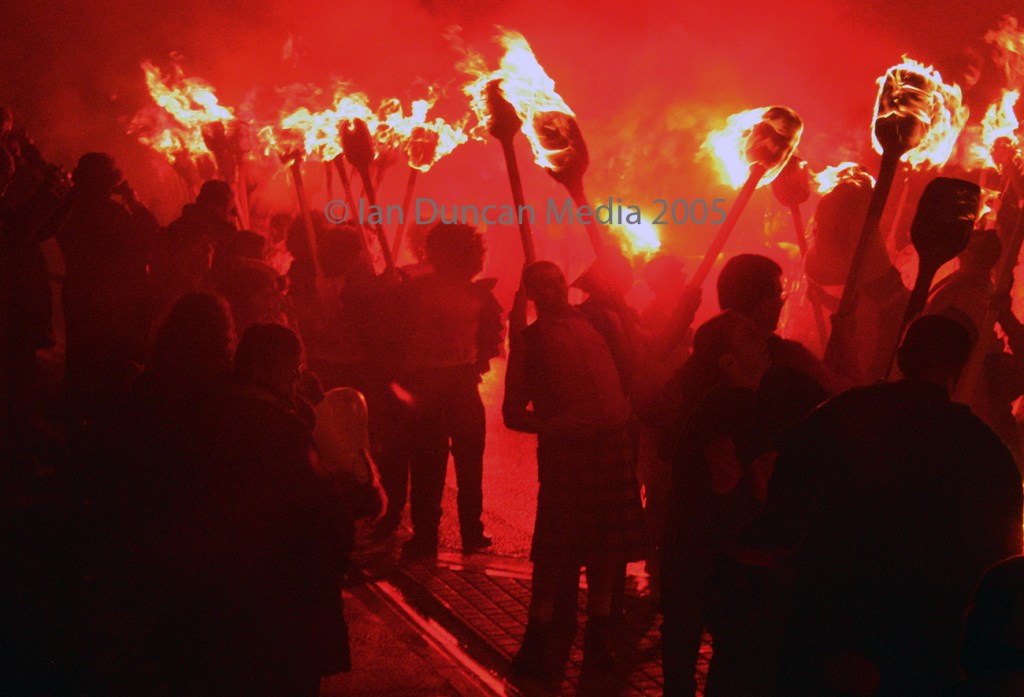
The squads start lining up around 7pm. At the signal of a flare – usually at 7.30pm – the torches are lit and the galley is led through Lerwick’s streets to the burning site.
With all the costumes and torches, you can step back in time and imagine you are witnessing the funeral of some great Viking warrior.
The men circle the galley, singing traditional songs, before hurling their torches into the galley.
This happens whatever the weather – it was trying to snow the year I went.
All the squads now disperse to do the rounds of the halls. This is when the serious partying begins.
There are several halls and you can get in by ticket only.
Not all the squads are Vikings, each will have some theme and when they arrive at one of the halls they perform a satirical sketch.
The Shetland Islanders certainly know how to have a good time – there is Scottish country dancing well into the early hours.
I left the party at 6am and the islanders were still going strong.
Not surprisingly the town was very quiet the next day. As I wandered through the almost empty streets that afternoon the only signs of life I encountered were people staggering back from the night’s festivities.
I recommend the trip but pack your winter woollies and be prepared for a very rough ferry crossing.
From the North West Evening Mail on Saturday, February 18, 1995.
Spirit of old Norsemen still burning brightly on Shetlands
A festival to fire your imagination
I HAD travelled as far north in the British Isles as I could, and at the coldest time of the year – but I had my reasons.
And my feet crunched onto the thin covering of icy, snow as I stepped off the ferry in Lerwick, the capital of the Shetland Isles.
My dad had always said I had Viking blood coursing through my veins and, with his side of the family originating from the windswept isles, there was a good chance he was right.
I had come to see three of my cousins help burn a handcrafted longship because they were members of the Jarl Squad – the main group involved in organising the festival of Up Helly Aa.
On the Sunday before the celebration, I followed the squad on their last chance to practise before the event and pose for a group picture for the official programme.
I had to admit the group looked impressive all dressed in their navy blue kirtles, sealskin cloaks, boots, shields, swords and helmets complete with raven’s wings.
But I could not help but think their knees must have felt the cold as they stood on a rocky outcrop in the face of an icy blast from the North Sea.
Even though it was more than 1000 years since the Norsemen first settled on the islands, their influence is still alive and nowhere more than the midwinter festival.
Up Helly Aa was a descendent of the Ancient Festival of Yule which the Vikings held to celebrate the rebirth of the sun.
There was much eating, drinking and dancing around the midwinter bonfires and the Norsemen eagerly looked forward to the 24th night after Christmas to hold their traditional celebrations.
This became known as Uphalliday – literally the end of the holidays – which later changed to its modern name of Up Helly Aa.
At the end of the 19th century it was decided the festival should be held on the last Tuesday in January, a date it still retains.
In the 19th century it took the form of tar barrelling. This involved various groups of guizers, men in disguise, pulling blazing barrels of tar through the streets of Lerwick on sledges.
The barrels were pulled to a pre-arranged site where a bonfire was held. But the main street of Lerwick in the mid-19th century was very narrow, and rival groups often clashed in the middle.
After complaints from the middle classes about the general disorder, which broke out, tar barrelling was suppressed during the 1870s. But the tradition was later revived with a few new ideas.
For a start the festival was held towards the end of January, a far more elaborate element of disguise – guizing – was introduced and organisers also brought in a torchlit procession.
Apart from the galley, the torches were the main feature of the festival, so I decided to see the preparations needed to make more than 1,000 fuel-soaked torches.
They measured about six feet in length and the head was wrapped in five Hessian bags, which soaked up half a gallon of paraffin. Also, to stop the burning fuel dripping on the torchbearer, there was a plug of cement.
Ally Watson has been a ‘torchboy’, or torchmaker, since 1978 and he said the festival was a ‘community thing’, which everyone celebrated together.
“It’s something you do, you get on with it. You miss it if it’s not there. We make torches and we enjoy it. There is a camaraderie,” he said.
And with the next batch of torches left steeping in the tanks of fuel, and two hours to kill, there was no choice but to retire to one of Lerwick’s many harbour-front bars.
The main man of Up helly Aa was known as the Guizer Jarl and was the head of the Jarl Squad, the one group which is usually dressed as Vikings.
And for the Jarl it was the most important day, one which would stay with him for the rest of his life.
In the bar I bumped into a former Jarl, Allan Anderson (70), who had the honour in 1971, as the historical Viking personality, Tore the Hound.
“I was looking forward to it, it was absolutely magic,” he said. “Walking up the ranks and everybody is cheering you. It was a great honour.”
I asked him if he would like to do it again, and his eyes filled with tears. “You could never, ever repeat that,” was all he could say.
I had an early start on the day of Up Helly Aa – 6am – because I had heard they would be moving the Proclamation to the Market Cross in Lerwick.
The Proclamation, known locally as ‘the Bill’, was an ornately decorated wooden board which stood about 10-feet tall and was full of in-jokes, usually at the expense of the Guizer Jarl and the local council.
And it was an impressive sight, being carried through the streets before sunrise, complete with its very own torch lit procession and rousing cheers.
And after a breakfast at the British Legion, Guizer Jarl Peter Fraser and his squad escorted the thirty-foot galley through the town. It was called Pete’s Dragon and had been painstakingly built by craftsmen during the previous year. It seemed a pity it would end up as a pile of ashes.
And as the squad marched through the streets, yelling their battle cries to the waiting crowds, they were clearly enjoying every minute of the day.
Up Helly Aa really kicked off later in the evening, with a junior version of the galley burning. Then at 7pm, nearly 1,000 torchbearers from 47 squads assembled in two long ranks and waited for lighting up time.
The Jarl Squad marched along the ranks, almost like a military inspection, and at 7.30pm a maroon was fired and the torches were lit. Even where I stood, about 15 feet away, the heat was intense and I felt my eyebrows disappearing.
And, as the ranks marched through the streets of Lerwick with the galley at the head of the procession, it was certainly an impressive sight and one you had to be there to fully appreciate.
Finally the guizers formed a circle around the doomed craft and sang traditional songs before casting their burning brands into the boat, which caused a great shower of sparks to leap into the air.
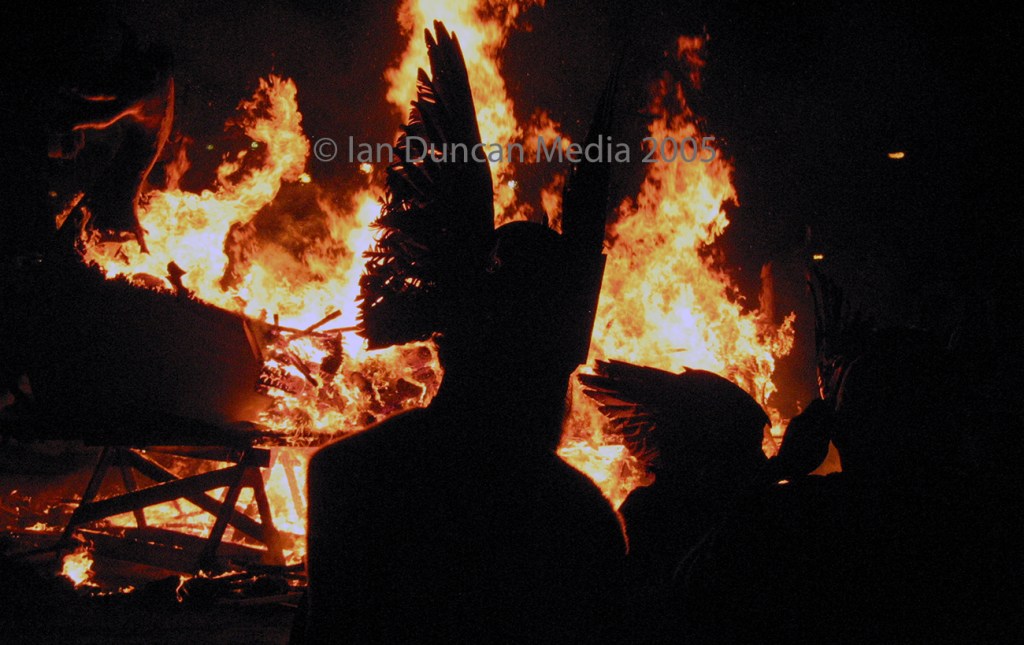
Guizer Jarl Peter Fraser – Earl Sigurd o’ Gord – said he was pleased with how the day had gone. He said: “Everybody seemed to enjoy themselves and it’s gone like a bomb.”
And after the flames started to die down, the serious partying was to begin. All of the squads were due to visit 12 halls across the town, for after-festival parties.
I ended up at the British Legion and saw several of them, each dressed in bizarre costumes and they all performed a sketch or dance upon their arrival.
I left at 4am, having stayed the distance for 22 hours. I would still probably be called a soft ‘soothmouther’, but I had enjoyed the day.
The next day was a public holiday in Lerwick and if you were up early enough, you might have caught the bizarre sight of various squads, still in fancy-dress, as they slowly made their weary way home after the night’s excesses.
I was still not sure whether I really had Viking blood, but I left the islands having received a welcome as warm as the burning galley.
The islands are worth visiting at other times of the year, where you can spend time exploring the 1,450km of coastline, taking part in a number of activities, including bird watching and walking.
Travelfacts:
Northlink Ferries sail overnight between Aberdeen and Lerwick and for more information visit: www.northlinkferries.co.uk
For more information visit: https://www.visitscotland.com/destinations-maps/shetland/ and www.shetland.org
From the Scunthorpe Telegraph on Saturday, February 26, 2005.
 Ian Duncan Media
One thought on “Having a flaming good time up with the Shetland Vikings”