Organ transport service makes 10,000th trip

It started as a routine call from a Scunthorpe-based ambulance service which specialised in transporting donor organs to patients desperately needing transplant. It turned out that they were travelling to Europe to collect a heart which would be flown to London’s Great Ormond Street Hospital. Would I like to get on the flight? Erm yes please. This was my first foreign assignment and the trip was on a private jet. The problem was my parents were down for a few days and I had to quickly explain that I would not be around for a day or two. So I caught the flight and landed in Scandinavia (can’t be more specific even years later). But when they turned up at the hospital with a journalist in tow let’s just say the hospital was slightly miffed and the proverbial hit the fan. Let’s just say numerous phone calls were made to my news desk and the resulting story was heavily rewritten to satisfy the powers that be and bore a passing resemblance to what I wrote. Anyway I was pleased to have highlighted this vital service. In a bizarre coincidence it turned out that they transported the donor heart that Sally Slater received when I was working as a photographer a few years earlier – my photo of her on life support made the nationals and helped to raise awareness of her plight which I hope helped to save her life…

“My work is very satisfying with the knowledge I am able to help in an important stage, to get a donor organ from one place to another, safely”
Liz McKinley
A SCUNTHORPE-based specialist ambulance service, which travels the world helping to bring patients and organ donors together, is celebrating 10.000 successful transport operations.
For the milestone trip. the company transported a pancreas from Scotland to a hospital in London, but Amvale staff will go to any lengths to collect vital organs which are needed save the lives of patents waiting for a transplant.
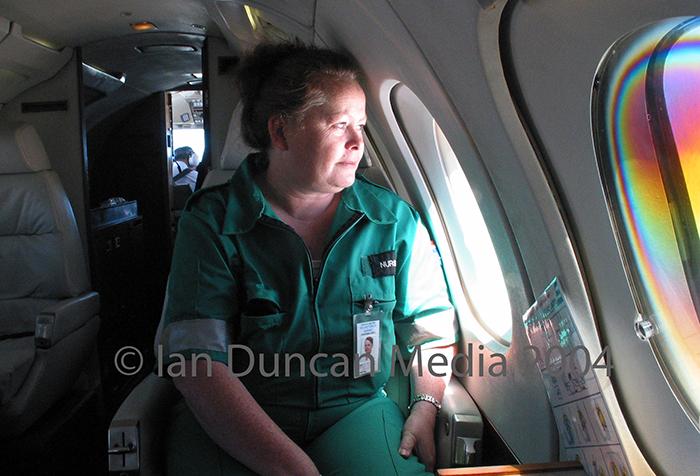
In one case health staff from Amvale Medical Transport Division went to Greece to collect a donated liver, within a tight time limit, and brought it back for a patient in the UK.
But, with organs such as the heart and lungs, time is even more critical and the organs cannot travel
as far for them.
Once the blood supply is cut off from the heart, it needs to be out of the donor patient and
into the recipient within four hours – often giving Amvale just two to three hours to complete the transport operation.
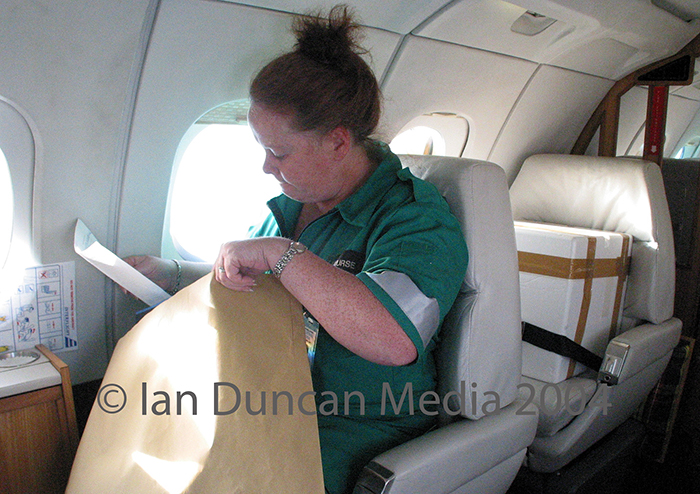
This means the area covered is limited to countries nearer the UK – and the whole operation is co-ordinated from the Scunthorpe base on Queensway.
Phone calls are made to arrange flights and ground transport to whisk the organ as quickly as possible to its destination – and the patient in need of a life saving operation.
Last week alone they had two mercy flights to organise, one to Ireland for a set of lungs and the
other to Europe for a heart. Between April 2003 and April 2004, the service made 101 emergency
flights.
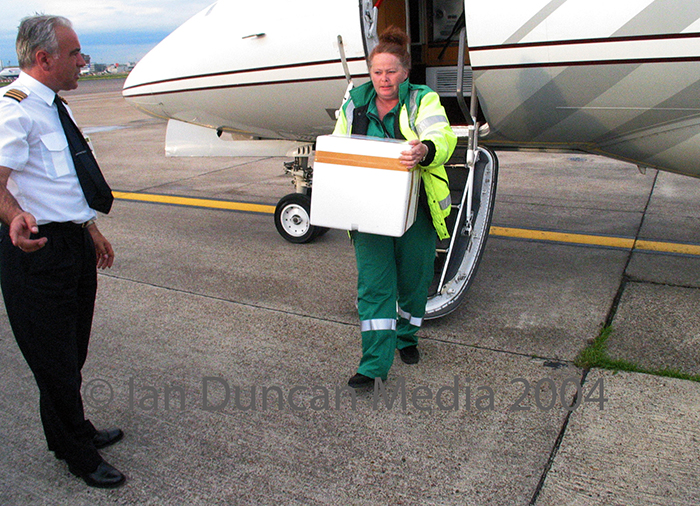
In the same week staff were also called upon to transport six kidneys four specimens, seven patients, one lung by car, two hearts by car, two surgical heart teams, two surgical renal teams and one set of eyes.
Head of operations, Peter Brown (45), said: “We are responsible for getting the job done by whatever means. we nave never failed to give the option of emergency transport to an NHS service.”
He added the company had resources throughout this country and had contacts with people who could provide transport at short notice.
“The company started in 1988 and we operate 250 special needs vehicles around the region. The transplant for transport side began in 1997.”
Mr Brown said with donor hearts, time was critical. He said: “If it can’t be done within three hours, then it is a joint decision of the duty surgeon and Amvale whether to proceed or not.
“On some occasions the operation can be delayed, however most transplant donations are the result of tragedy and no further delay can be made.”

Registered General Nurse (RGN) Liz McKinley was involved in a mercy dash last week to collect a donor heart and knew she had just four hours to collect the organ and get it to the patient.
Mrs McKinley, who has been a nurse since 1977, said sometimes they set off to collect a donor organ and were turned back halfway because it was not suitable.
“Normally I would take patients on the plane. Today I am going for an organ, and I have limited information. I don’t know who the donor or the recipient is,” she said.
She added: “My work is very satistying with the knowledge I am able to help in an important stage, to get a donor organ from one place to another safely.”
From The Scunthorpe Telegraph on Wednesday, July 14, 2004.
 Ian Duncan Media