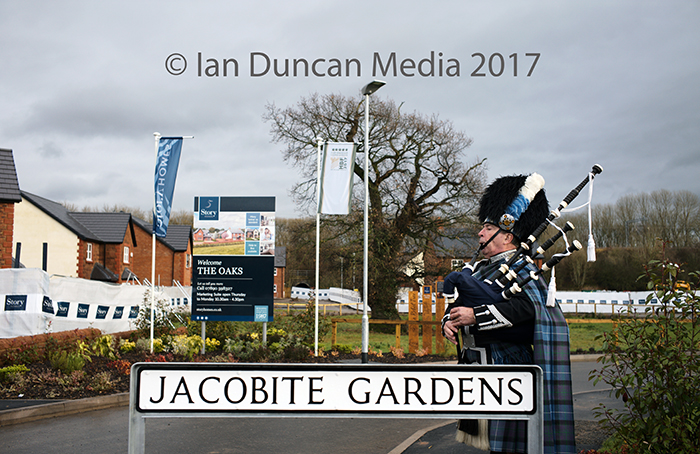
It was bizarre that there was a site near Penrith which dated back to the last battle on English soil which happened during the Jacobite rebellion. This marked the anniversary of the event and it is believed that the tree marked the place where the Jacobite soldiers who died were buried. It was also known as the hanging tree which might hint at how some of them might have died…
A LONE piper broke the silence in an Eden village at the weekend when a ceremony took place to mark the anniversary of what is widely regarded as the last battle on English soil which took place more than 270 years ago.
The Battle of Clifton Moor took place on December 18, 1745, and on Sunday, John Black, a historian and leader of the Scottish Jacobites Party, laid a wreath to remember fallen Scottish soldiers in Clifton.
His ceremony, known as Blue Bonnets Over The Border, centred on the Hanging Tree. The ancient oak, which is also known as the Rebel Tree, stands at the south end of the village and is thought to mark the final resting place of 12 Jacobites.
Speaking after the event, Mr. Black, who had travelled from Helensburgh, said the weather had been atrocious during his journey south but when he got near Penrith it had brightened up which he described as a “magical moment”.
The 400-year-old tree, which is protected by a preservation order, now marks the entrance to The Oaks estate.
Story Homes was granted planning permission for a residential scheme of 110 homes and a roundabout now surrounds the tree which marks the entrance to the development.
Mr. Black said he was hoping for a bigger turnout as it was important to mark the occasion because the tree was a “Scottish war cemetery which should be treated with respect”.
He added: “It shouldn’t be the centrepiece of a roundabout at the entrance to a housing estate.
“The ultimate aim is to raise enough money to buy these houses and bulldoze them. Clifton deserves a proper village hall and a memorial for the barrow.”
A Story Homes spokesman said The Oaks estate was named to honour the tree which forms a “striking entrance” to the development. Although an archaeological investigation did not confirm the presence of a mass grave the company had ensured that it was respectful to the history of the land and would ensure the Rebel Tree remained protected in the years to come.
The tree was where the Jacobites were reportedly hanged following the battle, which was more of a skirmish, between the forces of Britain’s Hanoverian government and Jacobite followers of Prince Charles Edward Stuart.
It occurred as the rebels retreated northwards towards Scotland, having at one point reached Derby.
A tree preservation order was served by Eden Council on September 26, 2014, and in April, 2016, there was an archaeological investigation of the area around the Rebel Tree.
However, it unearthed nothing of significance and no human remains were found. Because the tree is covered by the preservation order, archaeologists were unable to dig within a 20-metre buffer zone.
A separate specialist tree radar root survey was carried out, as well as geophysical and metal detector surveys, and a total of 11 trenches were dug within a 100m radius of the tree.
According to the report by Wardell Armstrong Archaeology, only five finds could potentially date to the time of the skirmish: four musket balls and a possible token.
It concluded: “It must also be noted that the investigation area did not infringe upon the 20m buffer zone around the Rebel Tree. Consequently, the presence of a rumoured mass grave containing Highlanders killed during the skirmish near to the tree could not be refuted but seems unlikely.”
From The Cumberland & Westmorland Herald on Saturday, December 23, 2017.
 Ian Duncan Media
One thought on “Piper sounds lament for fallen Scottish soldiers”