
Reporter IAN DUNCAN talks with local historian Tony Rowley on the notorious First World War bombardment of Scarborough by the German fleet.
TOMORROW marks the 93rd anniversary of the notorious bombardment of Scarborough by the German Fleet, and a local historian has discovered a town map which pinpoints where every shell landed.
Tony Rowley, a 49-year-old local history teacher from Rothbury Street, said the map was originally compiled by Scarborough Council and he had known of its existence for at least 20 years.
He said: “It says it was put together by Mr Smith. It can be put together to show where all the hits are. It’s important people can see it and see how the town was assaulted.”
A total of 500 shells rained down on the town after the powerful ships’ guns opened fire.
Three local trawlers were damaged, along with more than 200 properties, including major landmarks such as Scarborough Castle, the lighthouse, the Town Hall and the Grand Hotel, which was hit by 30 shells.

There were many narrow escapes and 18 people were left dead, including a baby and two boys, and hundreds more were injured.
In a propaganda postcard, the Germans claimed that the town’s guns opened fire on the ships but Mr Rowley said Scarborough’s defences consisted of a rifle brigade and pre-20th century cannon.
Mr Rowley said apart from the destruction the bombardment had a strong impact on the town and it could have swelled the ranks of volunteers wanting to join the Army.
He said: “At approximately 8.05am three German ships were sighted off Castle Hill and all hell broke loose. It was so indiscriminate.
“This was a place where the well off were coming for their Christmas holidays and war was still a sport to them. They had not heard of the horrors of the trenches and it was supposed to end by Christmas.”
Scarborough was also a place where the Channel Fleet regularly visited and Mr Rowley said it was thought the German navy could have attacked to make a point to lure the British navy into battle.
The event was initially censored by the Government and information started to surface by December 27 and 29, 1914.
Mr Rowley added: “As many people as possible were trying to get out of town during the bombardment and they weren’t leaving anything for the Germans.
“People who could not afford to get out had to hang fire and see what was going to happen. The Government let it out in stages because they wanted it to work to their advantage.”
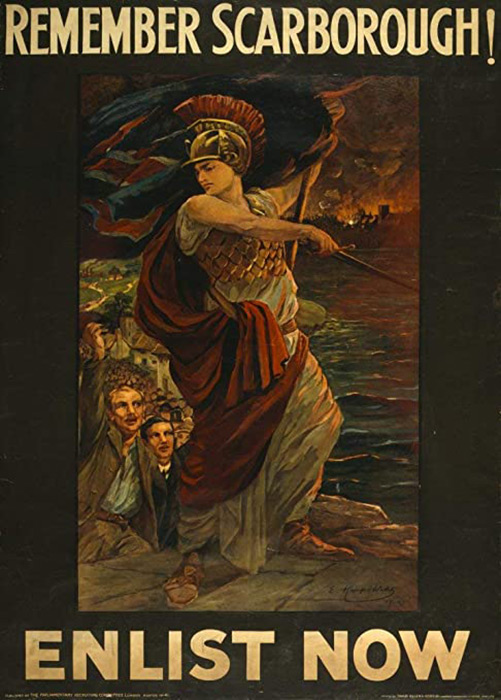
Posters, such as the one of Britannia which read “Remember Scarborough”, created a rush of volunteers wanting to join up and people even asked for German shells and shrapnel for recruitment displays.
The coastal towns of Whitby and Hartlepool were also attacked by the German fleet and the light cruiser Kolberg laid a trail of mines between Scarborough and Flamborough Head.
From the Scarborough Evening News on Saturday, December 15, 2007.
 Ian Duncan Media