
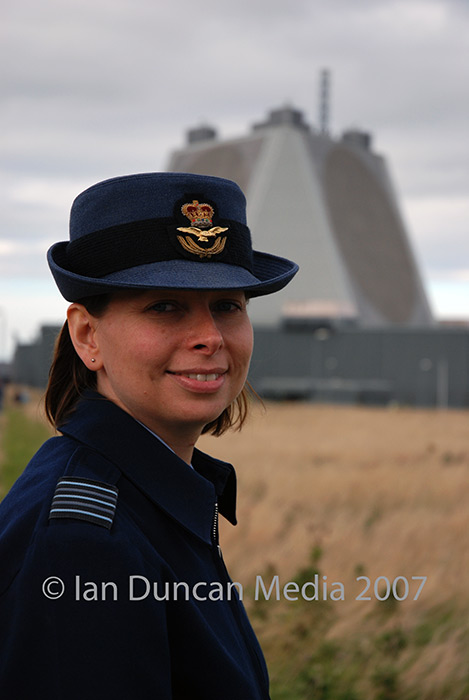
Everyone who lived through the Cold War era in the north of England will remember North Yorkshire’s RAF Fylingdales, an early warning radar station, known locally as the ‘golf balls’ because of their distinctive look. It looked more like a pyramid when I visited for a press call in 2007 when I actually met Martin Wainwright from the Guardian who was quite eccentric and an institution within the industry as well as being an influence for me. It was good to see the base had a female commander and we had quite good access during the visit. I returned the following month for a follow up feature.
SCARBOROUGH and North Yorkshire is at no greater risk from a terrorist attack than it was before RAF Fylingdales was upgraded, it was claimed today.
And the commander of the RAF radar station, which will become the eyes of the United States’ controversial Son of Star Wars anti-ballistic missile system, said her base remained very much under British command.
Defence Secretary Des Browne last week announced the four-year long project to upgrade the massive early warning radar at RAF Fylingdales was now complete.
It is expected the state-of-the-art equipment, which monitors up to 5000 objects across a 3,000-mile radius, will be certified for operational use this month.
Wing Commander Nicky Loveday, who runs the radar base, said the possibility of an increased threat had been assessed when the upgrade was first proposed. She said: “To have the upgraded radar would pose no threat to the station or to this area.”
She added: “This is an additional capability that can be used in circumstances where there is a situation which presents a threat to the United States. Realistically, the upgrade won’t mean we do anything different. It will just mean it is possible to provide greater detail of surveillance and tracking to the US.”

The upgrade was for both the hardware and software which enabled the base, part of a larger defence network, to track objects earlier as well as offering improved tracking capability.
Wing Cdr Loveday said another role for the base was to identify and provide early warning against missile attacks from hostile countries to the Government within a two-minute period.
She added there were definitely no plans to place interception missiles – which target an incoming missile and destroy it – in North Yorkshire.
Wing Cdr Loveday said the upgrade to the equipment meant the base had a viable future. She said: “The upgrade allows us to provide support to the US defence system. If the radar wasn’t here the station wouldn’t be here.”
RAF Fylingdales is the first base to monitor the space shuttle after its launch and is the last to track it before it lands back on the Earth.
The base provides a useful service by monitoring space debris and the position of satellites – and the information is provided to Government departments.
And she said that, contrary to popular belief, only one of the military personnel based at Fylingdales was American.
She said: “A lot of people think that this is just a token effort by the RAF. This is absolutely not the case. This is a joint operation here.”
The base was first declared operational in 1963 and was one of three radar sites in the Ballistic Missile Early Warning System.
It was originally dominated by the familiar golf balls, which were replaced in the early 1990s with the Solid State Phased Array Radar (SSPAR).
The SSPAR is a three-sided truncated pyramid which is about 40m tall.
Each face contains 2,560 modules and each produce a transmitter power of 340 watts – an overall power output from the three faces of 2.5 magawatts.

From the Scarborough Evening News on Thursday, August 2, 2007.
Fylingdales unique ‘eye on the world’
IN July the Government announced the completion of a four year upgrade at the radar base at RAF Fylingdales in North Yorkshire. Reporter IAN DUNCAN visited the base to see the new equipment in action.

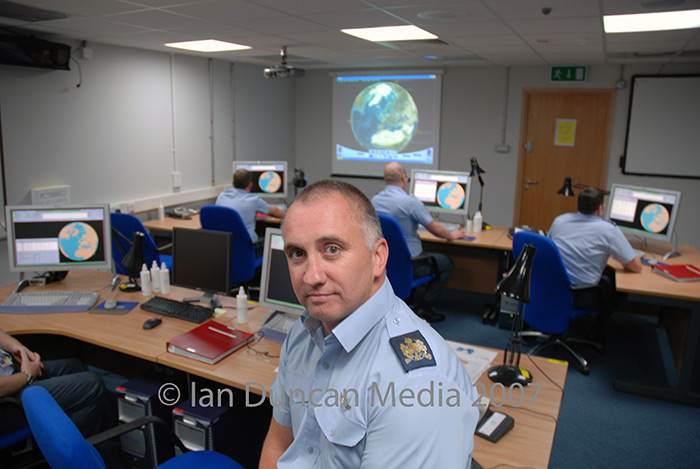

A CONSOLE operator signals that an object has been sighted just off the French coast, in the Bay of Biscay, and the control room’s crew of five immediately jumps into action.
Amid a clamour of shouts and commands staff are monitoring the object’s progress while trying to correctly identify what it is and its ultimate destination – all within a 60 second deadline.
On this occasion the object, indicated by a red cross on the state-of-the-art computer screens, was believed to be a French test missile and luckily it was just a simulation to make sure the team were able to handle a real emergency situation.
The Solid State Phased Array Radar (SSPAR) was declared operational in October 1992 and has just completed a four year hardware and software upgrade to bring it into the 21st century.
RAF Fylingdales has been embroiled in controversy after US authorities paid a claimed £400m for an upgrade to President George W Bush’s “Son of Star Wars” anti-ballistic missile system.
The base, which costs the British Government £16m a year to run, will continue in the prime role it has carried out since 1963 – giving an early warning of a ballistic missile attack on the United States and the UK.
Warrant Officer Ken Callaghan, who has 29 year’s service with the Royal Air Force, said it takes just over 10 weeks to train an operator and a total of five crews are stationed at the base. He said: “When you first start training 60 seconds passes very quickly but once you are here it becomes a very long time.”
He said this was his second tour at the base and people often requested to return to Fylingdales. He said: ”A lot of the senior NCOs are back here for second tours.”
Warrant Officer Callaghan said the new equipment made the job easier for the operators in the control room. He said: “It takes a couple of clicks of the mouse button. Things that used to take 30 seconds on the old system will now take 15 seconds.”
The present SSPAR replaced the familiar “golf balls” which dominated the North York Moors’ skyline since the 1960s and he admitted he felt nostalgic about their removal in 1992. He said: ”I’ve got a picture of them hanging on my wall.”
There are currently more than 30,000 objects orbiting the earth, some as small as a pen, and the radar equipment at RAF Fylingdales monitors about 4,000 of them every day.
As well as RAF Fylingdales’ primary role, of providing a continuous early warning against missile attack, it also carries out space surveillance, satellite warning and supports missile defence.
Flight Sgt Mike Bartlett explained some of the satellites were like TV detector vans in space which were listening for radio emissions and some military satellites were capable of photographing the newspaper headline which someone was reading in their garden.
He said: “We don’t do UFOs. Everything manmade is identified. We monitor anything that might pose a threat to our forces or is taking pictures of troops.”
Staff at the base also monitor objects whose orbits will decay and fall to the Earth’s surface. Flt Sgt Bartlett said: “The new system is working well. It is a quantum leap from what we had before.”
Wing Commander Nicky Loveday, the station commander, said the acceptance of the recent upgrade by both the British and American governments was a huge relief.
She said: “I don’t think the base was under threat. It is of strategic importance to the US and the UK. There was no suggestion that anyone would remove the radar.”
Wing Commander Loveday, who is 20 months into a 30 month tour of duty at the base, said there was no intention to base interception missiles at the base.
She said: “The national park has asked for reassurances that there is no intention that we are not going to base interception missiles here and as far as I know there is not.”
Factfile:
- RAF Fylingdales is a small unit on the North Yorkshire Moors and was first declared operational in 1963;
- It was one of three radar sites in the Ballistic Missile Early Warning System (BMEWS);
- The other two sites were in Alaska and Greenland;
- Today there are approximately 80 service personnel, 120 MOD policemen and women, and a further 250 civilian staff and contractors based at the station;
- The radar is capable of detecting objects within a radius of 3000 miles;
- It is housed in a truncated pyramid which is 120 feet tall;
- The three faces have a power output of approximately 2.5 megawatts.
From the Scarborough Evening News on Monday, October 22, 2007.
 Ian Duncan Media