I have done a few of jobs over the years which involved signal boxes on our railway network whether they be refurbished, decommissioned, celebrating an anniversary or decommissioned and fully restored. I have to admire the ingenuity of the Victorian engineering. Anyway here are several examples.

A SCARBOROUGH signal box is in line for a heritage award after being restored to its former glory.
The structure, at the end of the railway station’s platform, was first built in 1908 and has been painted in the British Rail colours from 1958.
Contractors have spent the past five months restoring the Grade II Listed Falsgrave signal box in consultation with members of the North Yorkshire Moors Railway.
Gary Booth, the project manager from contractors Construction Marine Ltd, said Dave Fenney from the railway had been a great help during the restoration.
The project, which was part funded by English Heritage, has been nominated for an award in this year’s National Railway Heritage Awards.
Construction Marine Ltd previously won an award in 2003 and was second for another in 2005.
English Heritage inspectors have already visited the building and the box is due for a second inspection later this month.
He said the original project was due to last 12 weeks, but his staff worked the extra two months. He said: “We’ve taken it back to 1908.”
Wooden signs have replaced the later metal ones and the steps leading to the signal box door have also been renewed.
Mr Booth described the colour scheme as conservation white and either monsoon blue or oriental blue.
Mick Hewitt, of Whitby, works as one of three signalman at Falsgrave and said it was the largest mechanical box in the country which still has its original workings.
He said he enjoyed working at Falsgrave but getting up at 4.30am for the early shift was a disadvantage.
From the Scarborough Evening News on Saturday, August 4, 2007.
End of the line for historic box

AT MIDNIGHT on Wednesday, October 6, more than 100 years of history will come to an end when the Falsgrave Signal Box closes for the last time.
The structure, at the end Scarborough Station’s platform one, was built in 1908 and Mick Hewitt will be on the last shift.
He has worked there for the past six years and said he would not miss getting up at 4.30am for the early shift.
He added: “It’s a nice box to work at, especially since they renovated it. Before then the windows used to rattle and the draughts used to come up through the floorboards.
“It could be spooky, especially at night, because you could be sat there and hear all sorts of noises.”
Thursday (October 7) marks the start of a major modernisation of the rail network around Scarborough Station.
The £60 million improvements include the replacement of the existing semaphore signalling with colour light signals, together with new points and track work – once complete signalling will be controlled from Seamer.
The signal box was restored to its former glory in 2007 and received the Westinghouse Signalling Award, as part of the National Railway Heritage Awards, the following year.
English Heritage part-funded the £180,000 project which took five months to complete in consultation with members of the North Yorkshire Moors Railway.
It was painted in the British Rail colours from 1958 and the colour scheme was conservation white and either monsoon blue or oriental blue.
At the time it was the largest mechanical box in the country which still had its original workings – there are 120 mechanical levers which are all connected by Victorian engineered interlocks.
In 2007 it was revealed that Network Rail planned to close it within a couple of years.
Mr Hewitt, from Park Terrace in Whitby, said he was sad to be leaving his job but added that it was part of progress for the rail network.
He added: “The thing is you can’t stop progress – if it wasn’t for progress the signal box would not have been here in the first place. It’s another step forward into the future of the railways.”
Because the signal box is a Grade II Listed building it will remain in place but it is still not known what use Network Rail plans to do with it.
Campaigners hope that it will continue to have some use – possibly as some form of tourist attraction.
But a nearby signal gantry bridge will be carefully dismantled and, after it is shortened by about 5.6 metres, it will be installed at the northern end Grosmont Station.
It dates from 1911 and is the last cross track semaphore signal gantry in use on Britain’s main line railways.
Semaphore signalling was introduced to railways in the middle of the nineteenth century and was the main means of signalling for Britain’s railways until the First World War.
And Mr Hewitt will not be too far from the gantry when it arrives at its new home because he hopes to volunteer with the North York Moors Railway when he finishes his final shift.
“Grosmont has semaphore signals so it’ll go well there. I’ve been volunteering at the North York Moors Railway since I was 13,” he said.
He added that he would probably help operate the signals for the steam railway as well working on the footplate as a fireman.
From the Scarborough Evening News on Saturday, October 2, 2010.
Guardians of the line
It’s 175 years this week since the railway line linking Carlisle and Newcastle opened. Ian Duncan speaks to the signalmen who continue to safeguard it

ON HIS first day at the historic Brampton Fell signal box, Billy McCormick experienced every signalman’s worst nightmare – a red runner.
The 58-year-old former factory worker had just completed the 13-week course to qualify him to operate signals along his stretch of the Carlisle to Newcastle railway line, near Talkin Tarn, when a car jumped the barriers just as they were coming down.
He says: “They went right under the barriers. My boss was here. He heard the klaxons going. He waited and the car went right past him. I took the car’s number.”
Warnings about the dangers of taking risks on level crossings has been the subject of high-profile safety campaigns. Unsurprising, Billy believes, given the fact the vehicles and those inside will always come off worse if hit by a train weighing several hundred tonnes.
Billy, who lives in Carlisle, started his career manning the level crossing at Milton, where he operated the barriers, before becoming a fully qualified signalman 12 years ago.
He says: “I’d actually been working on the railway at weekends when the vacancy arose. I applied for it, along with 2000 others, and they took three of us on.”
Billy adds that he found the work strange at first – because he had not realised what was involved and the fear of something going wrong – but he enjoys the job.
“When you look into the fields you can see all the wildlife and you can see the deer coming up the track.”
During our time there, bells ring to tell Billy that a train is on its way. He presses various buttons and throws the heavy levers to change the signals. Klaxons sound as the barriers are lowered and motorists wait patiently for the train to thunder past on its way to Carlisle.
Signalmen in neighbouring boxes communicate with each other using a Morse code signal to track the train’s progress and if they need to talk to each other there is also a phone system.
Billy laughs and compares going to signalling school, to carry out his training, with being back at school.
He adds: “You take an exam every week on what you’ve done each week.
“I wondered what I’d got myself into!”
Since qualifying he has had to keep up to date with the rules and regulations, with changes introduced every few months aimed at keep the rail network safe.
“There are certain sections of the rule book that you get asked questions on.”
Tim McVittie is the resident signalman at Low Row and has been a signaller for 22 years. The 52-year-old former postman, who lives in Milton, says that when he was younger his family ran a village post office in the north east and he used to go to the station to collect the mail.
“I used to travel to school by train and my brother was always interested in trains – he still is. The railway was always there,” he says.
He adds that the east-west rail link is an important part of our heritage. “It’s connecting one side of the country to the other – it’s an important artery.”
Tim started as a relief signalman, covering at various boxes wherever he was needed, before taking up his current post at Low Row 17 years ago.
He agrees that one of the perks of the job is enjoying the “peace and quiet” and adds: “You are working on your own. You can either do it or you can’t. Some of the lads that take it on can’t hack it.
“There’s a lot of responsibility. It doesn’t bear thinking about – if you sit and dwell on it you’d go round the twist.”
One of the more memorable events during a winter night, about 1998, was when he was startled by an explosion. A truck had hit the corner of the signal box and smashed an outside light.
Tim says: “The corner of the signal box was missing and there was a lorry going over the crossing. The guy got out of the wagon, had a look, then cleared off.”
He adds that it turned out that the truck had been stolen and because the building was now open to the elements he had to sit there wearing his hat and gloves just to keep warm. “They found the trailer of the wagon a couple of days later,” he said.
Unlike the Brampton Fell signal box, the one at Low Row was upgraded to electric switches, instead of the levers, in 2009.
The modernisation even stretched to air conditioning and an inside toilet. Tim laughs and says: “It’s absolute luxury. It brings it into the 21st century.”
The levers in the box at Brampton Fell date as far back as 1943, but the system is due to be automated in 2018.
Dave Hillary, the local operations manager for Network Rail whose office is in a mothballed signal box at Haltwhistle, has worked in the area for about 20 years.
He says that the current signal boxes are of historic interest and when they are decommissioned they are often reused by heritage rail lines. He adds: “It’s a bit of history. To a lot of people railways are still popular.”
Following the change, the existing network of signal boxes will be replaced by 12 regional operating centres to cover the whole of the country.
Mr Hillary says: “It’s like all modern developments it just develops all the time – it’s modern technology.”
From The Cumberland News on Friday, June 21, 2013.
Mike helps restore signal box he had to close 30 years ago
‘I felt quite pleased that we had been able to secure its future’

WHEN Mike Carrier was an operations manager with British Rail he had to take the tough decision to rubber stamp the decommissioning of Armathwaite signal box.
It was a decision made even more painful because he lived in the small north Cumbrian village at the time.
He has, however, since played a significant part in preserving the Victorian signal box as part of a dedicated band of volunteers who lovingly restored it, bringing it back to its former glory.
Its decommissioning was part of a restructure of the rail network which also placed the historic Carlisle to Settle railway line under threat – and it was saved 25 years ago next week.
The axe was lifted on April 11, 1989, and Mike said that the decision to close the signal box was taken in 1983 because the number of trains using the line had reduced substantially. He added: “It was felt that certain signal boxes were no longer needed.”
Revisiting the signal box this week he said that it had originally been earmarked for demolition, but he was determined to save it.
He contacted the Friends of the Settle-Carlisle Line who managed to secure a stay of execution – and the hard work was about to begin.
Between 1990 and 1992, often using donated materials, eight restoration volunteers carried out their labour of love.
He said villagers regarded the signal box as “a piece of history,” and added: “By this time I’d retired so it was a different scenario.
“I felt quite pleased that we had been able to secure the future of it. I think it was a very proud day for the village when the work was finished.”
And the signal box is even more special for Mike because it brings back personal memories. He started his rail career as a box boy in the Derby area.
David Tomlinson, an 82-year-old who also lives in the village and helped with the restoration, remembered the signalman Sid Atkinson. He said: “I thought it was worth saving because of its historical importance.
“It was in a dreadful state. There were 40 panes of broken glass and the roof leaked. The corner posts were rotten.
“It hadn’t been used for 10 years but it’s been restored to a very good standard. I’m very pleased that it has been saved for posterity.”
Today the box is easy to spot, painted in the bright yellow colour scheme originally adopted by the Midlands Railway when it opened in 1899 at a cost of £240.
Ongoing maintenance is carried out by John Johnson, a 57-year-old tyre builder who works at Pirellis, who answered a call for help in 2002.
He said: “I was the only one who phoned up. I was already a member of the Friends of the Settle-Carlisle Line and it is part of the heritage of the line. It was the first signal box that the friends saved and renovated.”
He added that there was now another restored signal box at the Settle end of the line and after 10 years the Armathwaite box was badly in need of a lick of paint. He said: “That’s why I turned up in 2002 – to help out.”
And since then he has slowly taken over the running of the box, which is open to visitors every Sunday. He said: “Sometimes on a Sunday we get 16 people and another Sunday we can get none.”
According to Northern Rail, the Settle-Carlisle line is “a vital part of the bustling and vibrant towns and villages that stretch across the Pennines.”
Figures show that it carries 1.3 million passengers every year – 10 times as many as it did when it was under threat in the 1980s.
Among the line’s friends is Judy Morris, who helps keep the platform at Armathwaite station in tip-top condition.
She says the 25th is an important anniversary for the group adding: “It was a turning point because never again has any government tried to close a major railway line in the UK.”
Next Friday Michael Portillo, who presented a series of television rail documentaries, will travel along the historic route to Carlisle to mark the 25th anniversary.
During the 1980s, as transport secretary, he was responsible for saving the line and has said that it was the best decision he made during his political career.
From The Cumberland News on Friday, April 4, 2014.
Restoration of Victorian signal box “labour of love” for volunteers
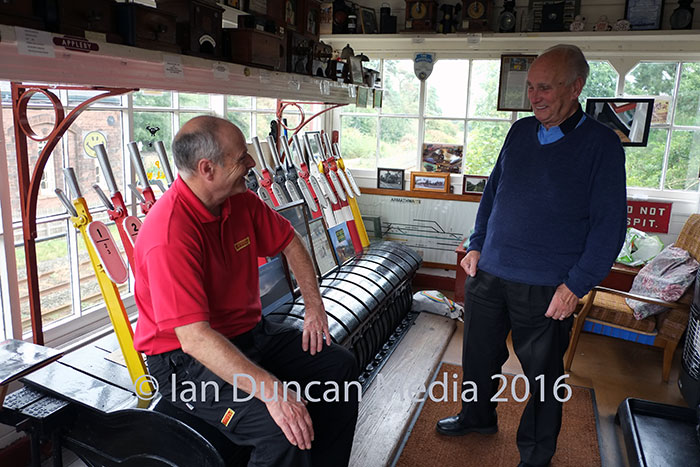
WITH the reopening of the Settle to Carlisle rail line just weeks away, part of Eden’s railway heritage is proving an increasingly popular tourist attraction along the historic line.
The entire length of the Settle to Carlisle line is expected to be open in March — some 16 months after the storms of December, 2015.
Network Rail has been working to repair the track after the major landslip at Eden Brows, near Armathwaite.
And a Victorian signal box in Armathwaite, which opened on July 16, 1899, replacing the original structure after it was destroyed by fire, is proving a big pull for visitors to the area.
Its decommissioning was part of a restructure of the rail network which also placed the Carlisle to Settle route under threat because the number of trains using it had greatly reduced — but it was finally saved when the axe was lifted on 11th April, 1989.
The box finally closed on 15th January, 1983, but a dedicated band of volunteers rescued it from demolition and have since lovingly restored it, bringing it back to its former glory.
When work began the box was in an advanced state of disrepair. There were 40 panes of glass broken, the roof leaked and the corner posts were rotten.
Between 1990 and 1992, often using donated materials, eight restoration volunteers carried out their labour of love.
John Johnson, who lives at Durranhill, Carlisle, originally got involved with the preservation project in 2002 when the box needed repainting, and said he had noticed visitor numbers were up this year.
The box is usually open on Sundays — and occasionally through the week by prior arrangement — and on one day he saw a total of 24 people, with 16 people turning up at the same time on another occasion. He added: “We get more visitors now. It’s probably doubled or trebled.
“To come and see it they’ve got to have a little bit of an interest in the railway to start with, especially the Midland Railway that is the company that opened this line.”
He said it was particularly good to be there in the winter when darkness falls and the station lights come on.
Richard Morris, who lives in Armathwaite, stepped down as chairman of the Friends of the Settle-Carlisle Line in April, after five years at the helm. He said the group was formed in 1981 to save the line and it was essential that heritage was preserved.
He added: “Network Rail wouldn’t bother with heritage signal boxes. We are very proud of our heritage.”
Ian Graham, who is 81 and lives in Wigton, worked as a driver and fireman on the line during his rail career.
He said there was a need for new volunteers to join the friends group. “We need some young blood to keep it going — otherwise it will just finish,” he urged.
The signal box at Armathwaite is a standard, timber-built, Midland type 2b design, measuring 12ft 6ins by 11ft 6ins by 8ft.
It was built at the Midland Railway Company’s workshops in Derby and was assembled at its current site at a cost of £260.
Outside it sports the bright yellow and red Midland colour scheme and inside it houses a 16-lever tumbler locking frame.
It is still owned by Network Rail — however it is classed as a “non-operational heritage asset” which was leased to the friends group in 1992.
As well as the frame, the signal box has been furnished with a number of interesting exhibits relating to both the building and the famous Settle-Carlisle railway that runs right alongside.
Michael Portillo, who presented a series of television rail documentaries, was the transport secretary responsible for saving the line and has said it was the best decision he made during his political career.
According to Northern Rail, the Settle-Carlisle line is “a vital part of the bustling and vibrant towns and villages that stretch across the Pennines”.
- The box is open on Sundays between 9am and 5pm (4pm in the winter) and visits at other times can be arranged. There is no admission charge but donations are always welcome.
From the Cumberland and Westmorland Herald on Saturday, January 14, 2017.
 Ian Duncan Media