
There was a regular feature called Scarborough People which ran every week when I was working in North Yorkshire. Basically you interviewed a well-known, or not so well-known person from the area about their life and wrote about interesting anecdotes they offered up during that conversation.
It was done on a rota basis and the biggest nightmare was thinking up suitable people to talk to. Having said that it taught me a lot including better interview techniques and the ability to bring an interesting story back to the office.
One of Scarborough’s best known exports during the early 1990s was the rock band Little Angels and years later the band members still had connections with the town.
Jim Dickinson was a prime candidate. As the band’s former keyboard player was working as a music lecturer at the local college. I did wonder how many of his students knew his history?
It was interesting to hear about his time as they gained in popularity and some of the tales from when they were supporting some well established bands – although I left out the quote about being offered a line from a massive pile of cocaine by a member of another band because I did not fancy a letter from their lawyers threatening legal action for defamation. For clarification the offer was politely refused.
MANY of Jim Dickinson’s students could be forgiven for not recognising him as a former member of a chart topping band who has supported many top rock acts. He spoke to reporter IAN DUNCAN about life with the Little Angels, getting shot in the head and his plans for the future.
GETTING shot in the head is traumatic for most people but for Jim Dickinson it proved the inspiration for his music.
Idolised by millions during the late 1980s and early 1990s, as the keyboard player with the Little Angels, he said some friends were messing about with a .22 rifle in woods by Gowland Lane in 1984 when the weapon went off and he was almost fatally wounded.
He said: “I was shot by my best friend but we never really spoke about it afterwards. To this day I still don’t know why he did it. When you get shot in the head and it’s a real gun you think you are going to die – I felt I was going to die.
“It’s quite an unusual experience and I had to walk for two miles back to the nearest farmhouse to phone for an ambulance.”
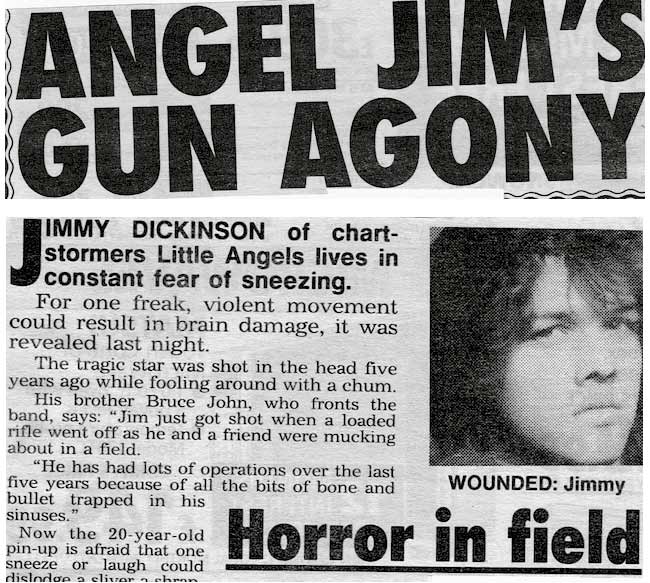
He said the bullet had broken into five pieces and there are still two bits left in his head – one near the optic nerve and the other near his jaw – and it was not unknown for a piece of the shrapnel to shoot out when he sneezed.
The injury resulted in numerous operations and a scar on the left side of his face which he tried to hide by wearing his hair forward and only posed for pictures on his right side.
He has recently returned to the scene of the incident but found it difficult to pinpoint the exact location because it has changed so much in the intervening 23 years.
He said: “A new forest has grown, since I got shot, in the passage of time. I want to bring the five people back together again and see what’s happened to their lives since that time.”
Jim said the area and events there had proved to be the inspiration behind his next composition, Wood From The Trees, which he hopes will form the basis of a PhD.
He said: “I get my music from trees. I photograph trees and use software to divide the pictures into different colours which can then produce sound. It’s quite beautiful, dreamy, electronic instrumental music.”
Jim had served his musical apprenticeship in various school jazz groups – including Scalby School Jazz Band and the Easy Band.
He said: “We used to do national competitions and played the Royal Albert Hall three times. At the age of 14 we stood on the stage of the Royal Albert Hall and said one day we will come back here.”
But he admitted he was a rubbish piano player when he was younger because he did not like playing other people’s classical compositions and preferred the freedom offered by musical styles such as blues.
He said: “The music teacher would have his head in his hands or go out for a break and then I’d play blues. That’s what got me started. It affects the way I teach.
“Music shouldn’t be elitist, one person might not be able to read music but could have a great talent. I just make it up as I go along and I just play in a unique way. There’s room for everyone. Music is just about expressing myself.”
The Little Angels formed a couple of years after the shooting incident and the original members included Toby Jepson, Mark Plunkett and Jim’s brother Bruce Dickinson.
He said: “We worked unbelievably hard and we had an amazing work ethic. We built our own rehearsal studios and we used to get complaints about the noise.
“In those days there no music colleges and we had to survive on the dole. We wanted to do this full time and nobody would help you in those days. I got kicked out of sixth form and we were doing things like rehearsing every day and travelling to London to play gigs.”
The band was getting a lot of recognition and played regularly at places like the Marquee Club. He said: “We funded all this by selling our own records. It was a follow-on from punk. We would press 1000 copies and sell them at gigs.”
A lot of bands were coming over from the USA and the Little Angels secured the much sought after support slot for the first British gig by Guns n’ Roses.
He said: “I have really strong memories about the show we did with them. They were pretty scary and I’d never seen cowboy boots before. I was 17 and it was a shock to come from Scarborough and see the LA rock stars.
“They were the real deal. Slash was walking around in his top hat and leather trousers all day. They were drinking out of brown paper bags because they didn’t realise it was legal and they smelled really bad.”
The Little Angels went on to have a number one album, 12 hit singles, four or five appearances on Top of The Pops and tours supporting Bon Jovi, Van Halen, Aerosmith and ZZ Top.
The band split after a sold out farewell show at the Royal Albert Hall to 6,000 fans in 1994. He said: “It was very special to us. It was our last ever show and we are very proud of it because a lot of bands keep going. A lot of bands from our era who are still going that shouldn’t be.”
After the band split up Jim has been involved with several projects including other bands, a record label and writing music for Playstation computer games.
But a lot of the creative process for his electronic music was a solitary pursuit. He said: “I missed working with other people. I was working on my own and I missed being in a band. With the Younger Younger 28s I made it into an electronic pop band.”
He started teaching music four years ago at the Brighton Institute of Modern Music and eventually landed a job teaching at the Westwood Campus of Yorkshire Coast College.
“I came back to Scarborough because I’ve got a young daughter and I wanted her to grow up here rather than in the South East,” he said.
“I started off with six students and now we’ve got 70. We are really proud of what we are doing and all the staff are from the industry.”
Question time:
Starsign: Pisces
Favourite films: Clockwork Orange and Mary Poppins
Favourite TV show: Porridge
Favourite food: Any fish that I’ve caught
Favourite CD: Rocket to Russia by The Ramones
Favourite holiday destination: Lake District
Favourite part of Scarborough: Alleys like the Bolts in the Old Town because they are good shortcuts and the tourists don’t know them
If you could invite any two people to dinner who would they be: Joni Mitchell and Jimi Hendrix
Ambition: To carry on writing music until I die
From the Scarborough Evening News on Tuesday, January 1, 2008.
 Ian Duncan Media