
Len Friskney was a regular contact who used to pop into the office with story ideas which were usually connected with his interest in local history.
Scarborough has numerous literary connections including the fact that Anne Bronte was buried in St Mary’s Church graveyard, on the castle headland, after she died in the town May 28, 1849.
Another figure with a connection with the town was the war poet Wilfred Owen who stayed there during his recovery from shellshock in 1917.
I have to admit that the poem Miners resonated because my grandfather was crippled by the industry when he was crushed by an underground roof collapse.
THIS weekend marks the 90th anniversary of the arrival in Scarborough of one of the most famous war poets.
And Len Friskney, an amateur historian and hotel worker, is hoping to increase awareness of the arrival of Wilfred Owen and his connection with the Clifton Hotel in Queen’s Parade.

He said: “It’s amazing how many people look up to him as a poet and a soldier. That many people come up to me and ask about him.”
Wilfred Owen fought on the Western Front but was badly shellshocked in April 1917 and was first sent to hospital in Edinburgh to recuperate. It was during this time he met fellow war poets Siegfried Sassoon and Robert Graves.
He arrived in Scarborough around November 23 of that year for light duties with the 5th Reserve Battalion of the Manchester Regiment and reported to the Clarence Gardens Hotel – which is now known as the Clifton Hotel – on November 24.
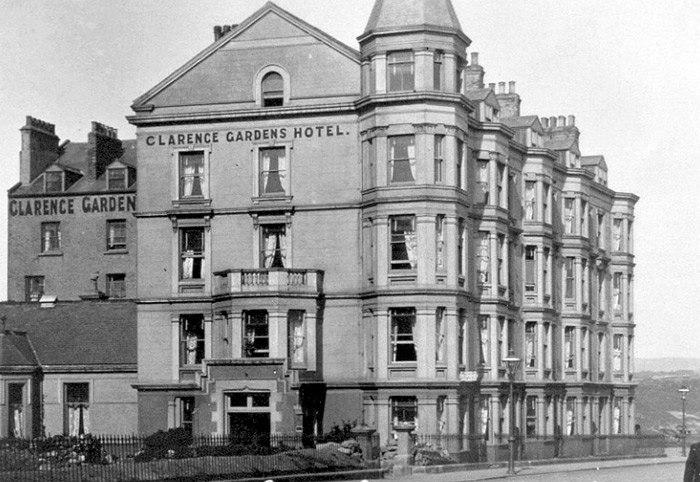
Mr Friskney said people regularly asked to stay in the room where the war poet stayed during his time in Scarborough. “He was the most unlikely soldier,” he said. “He wasn’t a pacifist but he did his duty.”
He added that the hotel charged the regular rate for guests to stop in the rooms where Wilfred Owen stayed. “Some guests are just interested in Wilfred Owen,” he said.
“Before the rooms were refurbished there was an Irish lady who came in and was in absolute awe that she’d been in the same room and said ‘I can feel his presence’.”
Mr Friskney said the poems produced by Wilfred Owen during his time in Scarborough are regarded as some of his best work and he singled out Miners as a prime example.
“Because of his experiences of that time he was able to express through his poems the futility of war, the suffering, the horror and death,” he said.
“The inspiration for Miners came as he gazed into the small coal fire in his room after he read that 140 men and boy miners had died in a pit explosion at Podmore Hall Colliery.
“It also reminded him of the dangerous work the soldiers of the Royal Engineers did while trying to tunnel under enemy held positions at the front.”
He added writing poetry could have been therapy to aid his recovery. “Being appointed Major-Domo – or officer-in-charge – he was able to choose his own room, which was one of the turret rooms – he could escape from his duties for peace and solitude to concentrate on his poetry.
“While at Scarborough over 50 poems were either drafted, written or revised plus a number of sonnets and fragments of other poems.”
After spending a few months in Scarborough he was posted to the Northern Command Depot in Ripon before returning to the Scarborough area, to Burniston Barracks, as the Battalion Messing Officer.
He was delayed going back to the Front because of an outbreak of Spanish Flu – about 30 officers were affected and many soldiers passed out while on parade.
Mr Friskney said: “He was killed in an attack on a heavily defended position, near the village of Ors, the main obstacle was the Sambre-Oise Canal which had to be crossed.
“After the battle he was found on the enemy side of the canal and his grave is in the communal cemetery with over 60 of his comrades.
“Many years have passed since his death but Wilfred Owen’s reputation has grown and is regarded as the greatest poet of that era who found inspiration in his own war experiences and the town should be proud of that association.”
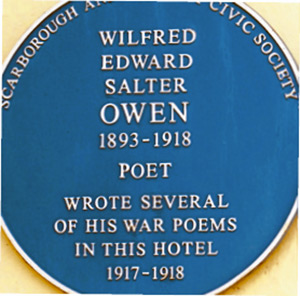
Wilfred Owen factfile:
- Wilfred Edward Salter Owen was born in Oswestry in 1893 and his family later moved to Shrewsbury;
- He first visited Scarborough on a family holiday in 1905 when was 12 years old;
- He enlisted in the Artists’ Rifles in 1915 and was commissioned the following year;
- Wilfred Owen joined the Manchester Regiment as an officer and went to serve in France;
- He suffered Neurasthenia – the medical term for shell-shock – in 1917 and was sent to Craiglockhart War Hospital;
- He returned to France in August 1918 and he carried a postcard of Scarborough to remind him of home;
- After the Joncourt action, in October 1918, he was awarded the Military Cross for conspicuous gallantry and devotion to duty;
- He was killed in action on November 4, 1918, aged 25, at Sambre-Oise Canal, France;
- Scarborough Civic Society recognised his association with the town in 1999 when a blue plaque was unveiled near to the turret room.
Miners by Wilfred Owen
There was a whispering in my hearth,
A sigh of the coal,
Grown wistful of a former earth
It might recall.
I listened for a tale of leaves
And smothered ferns;
Frond-forests; and the low, sly lives
Before the fauns.
My fire might show steam-phantoms simmer
From Time’s old cauldron,
Before the birds made nests in summer,
Or men had children.
But the coals were murmuring of their mine,
And moans down there
Of boys that slept wry sleep, and men
Writhing for air.
And I saw white bones in the cinder-shard,
Bones without number;
For many hearts with coal are charred;
And few remember.
I thought of some who worked dark pits
Of war, and died
Digging the rock where Death reputes
Peace lies indeed.
Comforted years will sit soft-chaired
In rooms of amber;
The years will stretch their hands,
well-cheered
By our life’s ember.
The centuries will burn rich loads
With which we groaned,
Whose warmth shall lull their dreaming lids
While songs are crooned.
But they will not dream of us poor lads,
Lost in the ground.
From the Scarborough Evening News on Saturday, November 24, 2007.
 Ian Duncan Media