
There were a number of meetings during the run up to the council vote and this was just one of them. Bizarrely I met my MP who was in Parliament when I was working in Barrow-in-Furness and south west Cumbria.
John Hutton was a good constituency MP for Labour while I was there between 1992 and 1996. On a job one time when I mentioned that I was learning to ride a motorcycle and whenever we met on future occasions he would always ask how the motorbike was running.
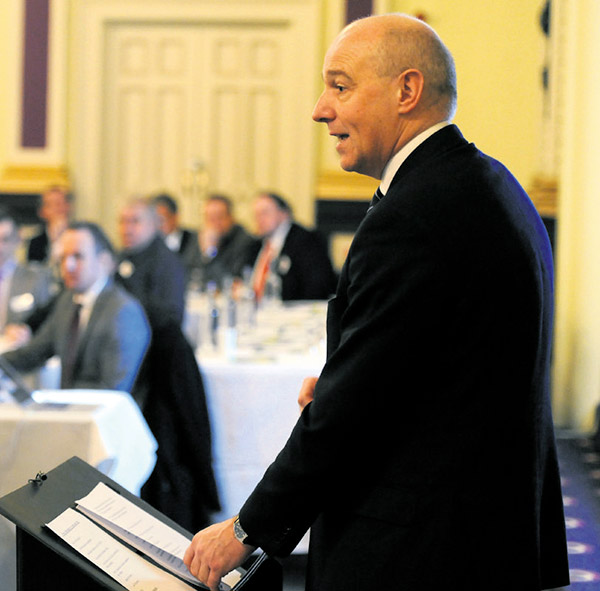
After Labour’s landslide victory in 1997’s General Election I believed he played a role in Tony Blair’s Governments and, by the time of this meeting, he was Lord Hutton of Furness and chairman of the Nuclear Industry Association. Which meant he was one of the speakers.
I spoke to him and reminded him of the motorcycle and he claimed to remember our conversations which I could well believe.
A crucial decision by three local authorities over whether to house an underground storage facility for nuclear waste delegates will be made next week. Political reporter Ian Duncan found out more at a seminar in Carlisle to discuss the arguments for and against
It has been a debate which has polarised all sides of the issue for decades – exactly how and where do we store the UK’s intermediate and high level nuclear waste?
On Wednesday senior councillors from three Cumbrian authorities – Cumbria County, Allerdale and Copeland – will decide whether or not they want to stay in the running to house an underground storage facility which could be as big as Carlisle.
Their decision on progression from stage three to stage four of the process will dictate whether detailed tests are carried out to fully assess the geological suitability of possible sites in the west of the county to house a geological disposal facility (GDF).
A meeting was organised by the Sellafield Workers’ Campaign (SWC) and Trade Unionists for Safe Nuclear Energy (TUSNE) yesterday which aimed to put forward the arguments based on facts and scientific research.
Kevin Coyne, the TUSNE chairman and national officer with Unite, says it is a trade union event. “We want you to understand the impact of the decision on January 30.
“For over 30 years the search has taken place for a suitable site and it is critical that positive moves are made on this decision.”
He added that it was not about destroying the tourist industry and the next stage was about carrying out geological tests and analysis.
“If the geological survey is unfavourable and there’s a safety risk we won’t support the GDF.”
More than 100 delegates were packed into the city’s Hallmark Hotel including local MPs, councillors, scientists, nuclear workers and industry leaders.
Opening the debate, Carlisle MP John Stevenson said that the fact that the meeting was being held in the city was significant, adding: “It is not just important to west Cumbria but to the whole of Cumbria.”
He said it was a decision important for generations to come which would last “beyond our lifetimes”. “Central Government has decided that we will continue to rely on nuclear power and we need a solution to the long-term storage of nuclear waste.”
Mr Stevenson also pointed out that such a move, as well as a possible new plant built at Sellafield, would also provide a welcome economic benefit – including extra investment from the National Grid as well as improvements to the transport network.
“This is a huge decision that should be taken for the right reasons. If it’s proven that there is a suitable site there’s still the opportunity to take a balanced decision, a decision made with our eyes wide open,” he said.
Mark Higson, chief executive of the Office for Nuclear Development, reminded delegates that nuclear waste was already being stored at Sellafield and between 629,000 and 1.16 million square metres of storage space would be needed.
He added that the study was not being rushed and that we have a “moral imperative” to future generations to get it right. “We need to make progress to find a solution,” he said.
Mr Higson said it would be a waste of time to do the research to identify a suitable site first – and then find out that the plan was not welcome by local communities.
“It doesn’t make sense to spend a lot of money and effort to find a site that the community isn’t willing in principle to accept. And every community doesn’t want to commit without knowing that the geology constraints are met.”
He said that the next phase of the process – the site identification and desktop studies – would probably take around five years and stage five would involve surface investigation.
It was only when stage six was reached that further underground investigation and final construction work would be started. Mr Higson said: “I don’t think the geology, at depths of up to 1000m, is all that well known.”
The investigations will also include issues surrounding hydrology – water flowing through the rocks – and already a number of areas in west Cumbria have been ruled out.
He said: “That doesn’t mean that we’ve identified other areas. I am serious, and Government Ministers are serious, that the right of withdrawal [for councils] is genuine.
“It’s a very important decision that local authorities are facing. I emphasise that it’s not a decision to commit. Going forward to the next stage doesn’t mean that you can’t withdraw for whatever reason.”
But he added that any decision needs to be based on facts and not who “shouts the loudest”.
John Clarke, the CEO of the Nuclear Decommissioning Agency, echoed his sentiment by calling for ‘more evidence and less emotion’ to be brought to the debate. “Is the geology suitable? Is the benefits package right?”
He added that industry and tourism within the county had always worked in harmony. “We’ve a long history in west Cumbria of tourism and industry working together and I don’t see why that can’t go into the future.”
Jamie Reed, MP for Copeland, said he was a third generation Sellafield worker and the twin pillars of the nuclear industry and the National Park were introduced by central government at the same time. “Put simply, Cumbria, and west Cumbria in particular, stands at a crossroads. In west Cumbria, if we take the right decisions there will be unprecedented economic growth.”
But he warned that if we took the wrong decisions then our fate may well be “out of our control”. “It is imperative that we move onto stage four.”
He added that if it was shown that the geology was not right for the project he would be the first to stand up against the repository.
Engineers have said it would be a bigger construction challenge than the Channel Tunnel, involve tunnelling between 200 and 1000 metres into the ground, around 1000 construction workers and would take an estimated 15 years to complete – at a projected cost of between £12bn and £20bn.
The waste would need to be stored for tens of thousands ofyears and it is understood that the work could begin in 2025 with completion by 2040.
However, delegates were greeted with a noisy reception, as objectors gathered outside the hotel for their arrival. A number of grassroots campaign groups against the plan have sprung up in recent months and protestors from several were outside during the seminar.
Dr Ruth Balogh, of the west Cumbria and north Lakes branch of Friends of the Earth, said that the event was advertised as putting forward the arguments – both for and against – but opposition groups had not been invited.
“Some people going in are agreeing with us and some don’t want to know the other point of view. The Government keeps changing the rules and the councils next week don’t know what they are signing up for.”
The process has always asked areas to volunteer to be considered as a suitable site but Dr Balogh stressed that there were no “willing communities”.
“The Government wants a willing community and a suitable site but they’ve got neither. We recognise this is a serious problem – it’s a national problem not a Cumbrian problem.”
Lord Hutton of Furness, chairman of the Nuclear Industry Association, said it was important not to let the arguments muddy the water.
“It’s a very important decision that has to made next week. It’s not a decision to have or not to have a GDF. It is the local communities’ decision. Let’s try to make our choice based on the evidence – that seems to be the fundamental principle.”
From the Carlisle News & Star on Saturday, January 26, 2013.
 Ian Duncan Media